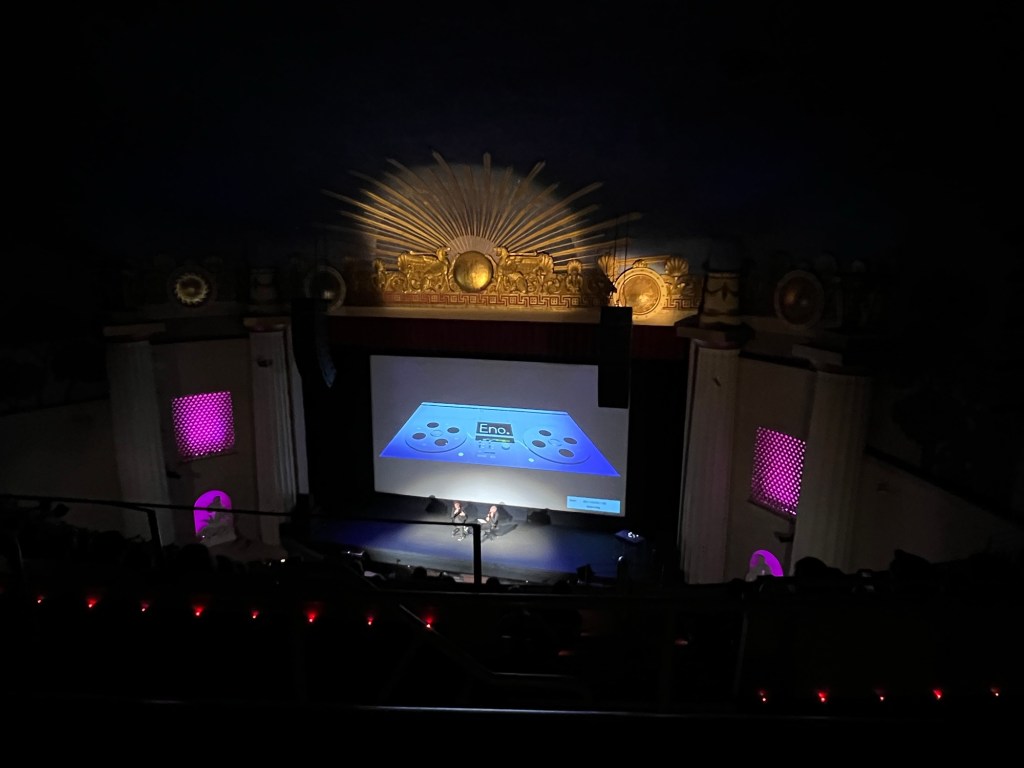
Eno Screening, May 4, 2024
Selise, my mother, often said to me as a child that I went to film school before I was born. That’s because she was pregnant with me as she was going to grad school as she was watching multiple films a day in the early 70s. I always loved movies and my earliest memories are of having screenings of films in our tiny Philadelphian apartment. My mom used to borrow the small amount of children’s films from her professor Bill Everson and there was something absolutely joyous about her lugging reels of film on the train to our house that made watching movies in our living room still one of the greatest cinematic events of a lifetime. Somehow I became obsessed with The Red Balloon at a very young age. Even as a child, I always wanted more of the film, I wanted to see Pascal’s life from every angle, I wanted to go home with the little girl with the blue balloon, I wanted to ride the trolley across Paris, I wanted to fly over Paris with all the balloons. But those actions were always left to my imagination over forty odd years of life, or interspersed with other films I eventually saw, like certain scenes from “Up.” There was only so much Red Balloon that existed and the rest was left to imagine. This to me was the beauty and the disappointment of cinema.
And then I saw Gary Hustwit’s generative documentary “Eno” last night in Glendale.
“Eno” is a vast and fascinating portrait of the influential British artist, producer and dare I say creative philosopher. Expressed in about a dozen thematic vignettes, it weaves the story of his work and life with his present reflections on climate change, music, time and space. It is a film that is constantly creating itself through the use of director Gary Hustwit’s collaboration with the creative technologist Brendan Dawes through an interface known as Brain One. Watch out HAL. What an anagram. Utilizing Eno’s archive of 500 hours of footage plus the interviews Hustwit shot over several years, while a few scenes are always the same, each iteration of the film is different, expertly edited in pieces by Maya Tippett and Marley McDonald, who could get an award for working on the longest film ever. There’s a rhythm to the pieces, not unlike a painstakingly curated DJ set where a DJ has spent a lifetime choosing, editing and arranging tracks to craft a unique performance each night.
The version I saw depicted early Roxy Music sessions, clips of Fela Kuti and The Talking Heads, time in the studio with David Bowie on “Heroes”, the recording of U2’s The Unforgettable Fire, collaborating with a solo David Byrne. And more. At times, it felt like I was watching an artist search through a three dimensional encyclopedia of clips and memories. Or maybe you could just call it a journey through his personal algorithm. I started to cry when he talked about the influence of Fela Kuti’s band on Talking Heads as the screen split into parts, one side Fela performing, the other the Talking Heads. It felt like a you had to be there anecdote that I always wanted to hear, with the accompanying clip, but it was meaningful, because I was there to hear it that night. On my night, there was also some Lee Perry. Win. The themes of control and surrender kept appearing, and I was happy to go along for the ride. Hustwit said at the Q&A, “I’m still making new connections about Brian, but I’ve been seeing this for 5 years.”
As the lights came on and the theatre slowly emptied out as the Q&A went on through the audience questions, I could have sat there all night, hearing the myriad of stories of the making of the project and all the tech required to be the first in the space. How often is it that a filmmaker has to invent tech to let the film be streamed? In the 14 years I worked in the streaming space, I spent so much time and energy trying to convince artists to participate in feature actions, but maybe this approach was too small. Maybe the action that has been needed all along is some generative platform that allows contextualized experiences out of all the creative universe an artist embodies?
A little more than a month ago I attended a Theo Parrish talk about creativity when he was briefly in LA. Theo has been a long musical hero of mine, and I’ve carried his music throughout my life from the first mixed cd I was given in Frankfurt decades ago to now. I’ve always admired his originality and risk for playing beyond genre and timespan, for approaching a dj set with the vulnerability of an improvisational live jazz band. I can’t really summarize what he said over the almost two hours, except it felt a lot like, “because you’re here you make art and I’m here to tell you to keep making it no matter what anyone says.” But I did write down a few things he said, including “your belief system is your practice,” and I think that’s a powerful theme that also emerges from watching “Eno.”
Leading up to the Parrish talk I was thinking a lot about the process as his talk was entitled
“Input/Output.” I painted this card, “The output is only as good as the input” and I’ve sat with that statement for many weeks now. As “Eno” lingers in memory a few days later, I think that the excellence of the editing input along with the thoughtful anchors placed gives the film this incredible container to create a powerful endless story. When I’ve worked on building new products, I always advocated that the first users are the ones that are the most creative and innovative because they “warm the room” for everyone that wants to come after. But maybe it’s just when you’re testing something first, you want to ensure that your first in is also going to be high quality. When you’re first, you have the power to set up the safeguards to be their best. I still want all the firsts to have that transcendence of that last shot of “The Red Balloon” when Pascal soars over Paris held up by all the city’s balloons. These euphoric moments set the tone for tech’s possibilities to connect audiences deeper to art. “Eno” does just that for me and I can’t wait to see it again.
 Carly Eiseman