
Bear with me as I write about this painting. If I don’t write this in pieces, the stories won’t emerge. So we begin. With an image. And I’ll write more here in the next few days.
day 1.
Writing thoughtfully about art is slow to me. I watch those around me who do cover art process it at a speed I cannot comprehend. So most of the time I just choke. I absorb the art but never process it. Until years later when often I see the pieces again and between the viewings, context occurs.
day 2. Awake in the middle of the night, I thought about black portraiture and how I never really thought about the wider subject of portraiture until I interviewed Kehinde Wiley and Mickalene Thomas about a decade ago. Their shared passion for portraiture and challenging historical norms for it very much opened me up to looking at figurative art in a new way. Prior I felt little connection to portraits, for they were usually of people I felt no connection with. But this 2010s movement to create a new culture around portraiture excited me and a decade later still does. Noah Davis’ work fits in as part of this story that I have been crafting in my mind.
day 3. I find contemporary art fascinating partially because it possesses an open gateway that was often absent in much of the art that came before it. Even as a young child when I thought of art, I often thought of ancient or religious work, or if people were featured in it, they looked alien, born long before the time I was in and mostly inaccessible.
In my purview, when I think about the art that drew me in to look closer and to feel, it was all created within 100 years of my birth in the 1970s. I’d like to call it contemporary art, art after the invention of photography, even though most times when people refer to “ca” it’s often post-war or after. But I’m happy to group this term much more broadly because I want it to include mass reproduction art and art made by traditionally non-artists. I set this stage because I keep pondering the why of my Noah Davis admiration. Looking at “Pueblo del Rio: Arabesque” makes me feel the same breathless way as I did the first time I saw George Bellows’ “Dempsey and Firpo.” I was a teenager at the time. I was very uninterested in visual art outside of photography. And then I saw this Bellows show at LACMA where he painted his life, the city, his family, sport, the Maine coast and everything changed. It wasn’t that I didn’t like painting I realize now, it was just at the time, I wasn’t very interested in the subject. I am very intrigued by everything Bellows and subsequently Davis, separated by almost a century of American life, painted.
day 4
There was a period of time when I worked in streaming where I spent all my days listening to other people’s marketing success stories. I collected these campaign anecdotes like a seasoned buyer. The campaign that still sticks with me is a story about an artist that kept changing his songs after their release. For a period of time, his album was constantly being refinished. I didn’t like the music nor the artist, but I loved the thinking before this release. It satisfied this potentially imaginary dialogue he wanted to have with his audience. Was his fan feedback impacting his changes? Doubtfully. But he couldn’t control his impulses to keep tweaking. I understand that. I think to write what I call the hard stuff, which the art writing often is, requires a rigorous concentration and often rewriting. What I comprehend now after many months of publishing silence is that I will never complete anything if I don’t share it in process. Because I lose interest and move on. There is a certain personal accountability to keep incrementally adding to the story if the story already exists. So here I am. Rereleasing every day and adding more to this piece about this painting and why I’m finding it is my light to making new art and thought in 2025.
Day 100
I’ve been going to the Venice Biennale now for almost 15 years. It is a life choice and obsession. A field research project that will eventually become a book or an art project in itself. When I tell people about this long durational art viewing project, they often ask me about my favorite pieces I’ve experienced. One of my greatest joys is collecting the memories of these feelings. Some are viscerally sensual like the smell of Delcy Morelos’ spices that lingered outside her earth room. Others are more internal, like the music that beat within me after viewing the work of Noah Davis’ brother, Kahlil Joseph. It’s a long video piece called “BLKNEWS,” a rhythmically edited montage film of contemporary black culture that has the surrealist punch of Leger’s “Ballet Mecanique” but with much more heft and grit. Like Christian Marclay’s “The Clock” it is impossible to watch it all in one sitting nor is that the point. The beauty of the Joseph piece is to sample it like it has sampled history, to drink from the richness and pain it chronicles and to leave thinking about the stories that drive culture.
My love for this piece of art is boundless. The work runs through its viewers. I believe it is meant to be felt, not analyzed. It is an education in perspective. I sat on a bench in Venice the year I saw it alone and I cried.
day 101
I thought today that if I had met Noah Davis, I would have asked him if he had seen “The Red Balloon” as a child. I know he did, but I still would have asked. I wonder if I would ask Kahlil Joseph that question. I think I would be too intimidated. Instead I would tell him that when I was 3, I told everyone my favorite record was “Songs in the Key of Life” and I never changed my mind.
Day 140?
Today I found in my Flickr account the photo I took the first time I saw the painting.
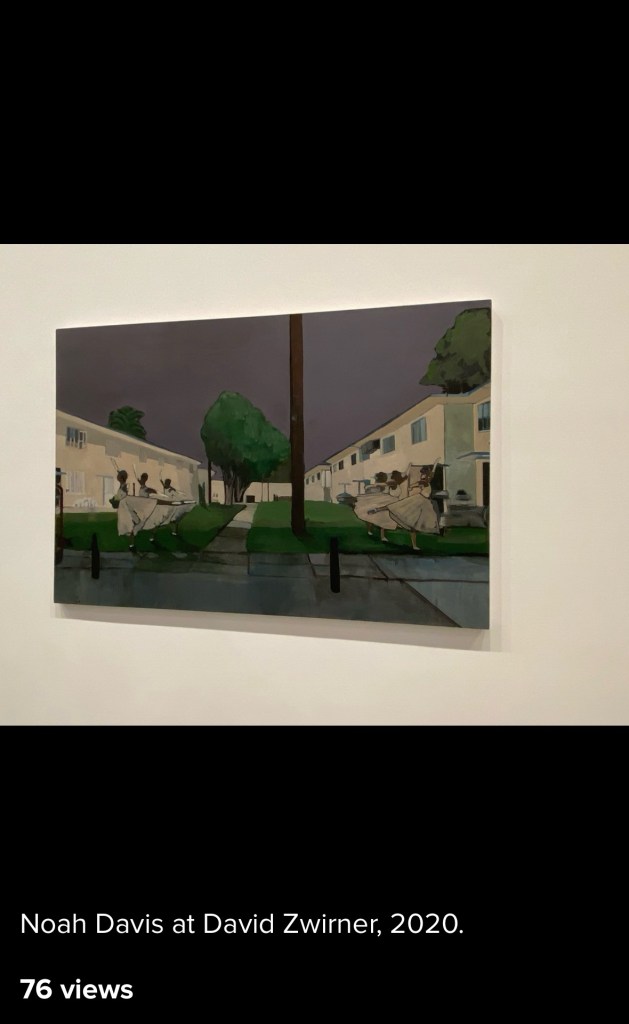
This was almost six years ago, a few months before lockdown, a cold winter night in Chelsea. I was struck by it then. It’s one of the last photographs on my original Flickr stream, a photography platform where for many years I tried to write a novel in photography.
Recently I was reading a New York Times style piece where different magazine editors talked about their favorite magazine covers of all time. This spurred the thought – what are my favorite paintings of all time and when did I first realize them?
 Carly Eiseman