October 2025.
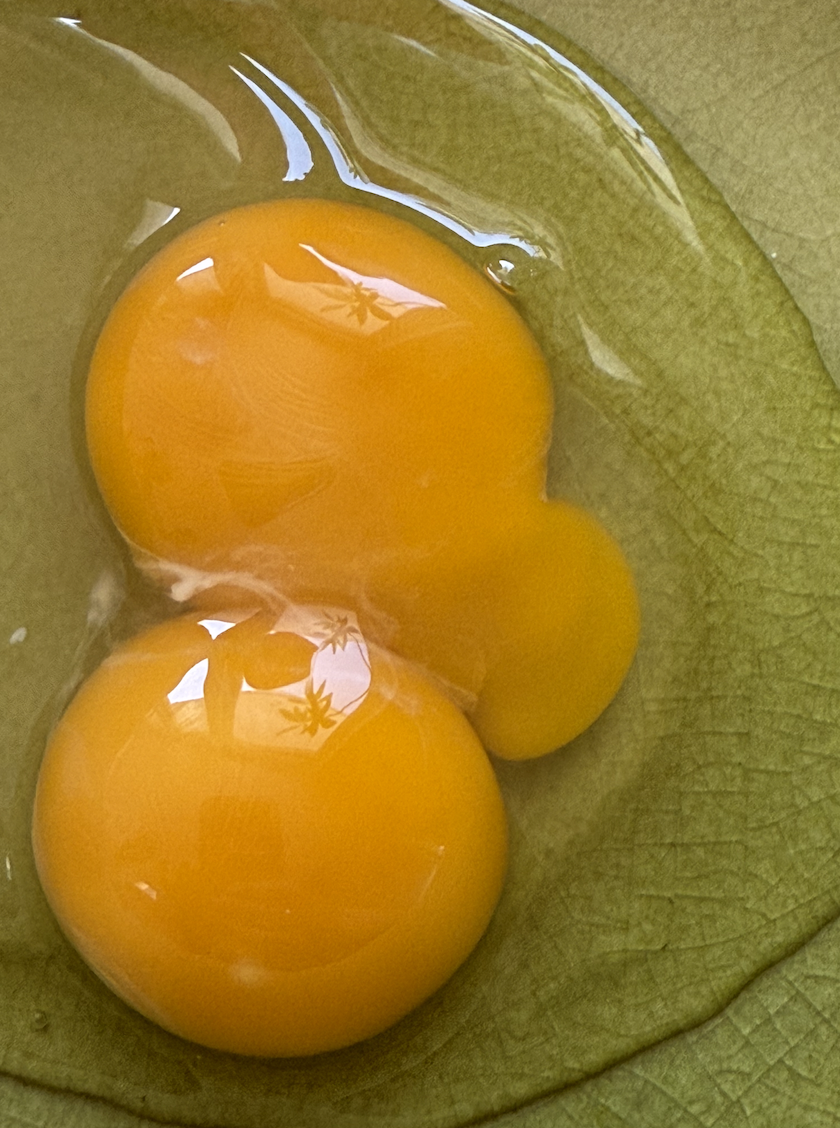
Lately I have been wondering about the scale of futility. This is in relation to creation in an age of AI. I contemplate how many other makers think that the time to share their ideas about culture is wasted if their ideas are inevitably going to be used as training for next gen LLMs, that will spew out iterations of thoughts at a pace exponentially unfathomable. And if they were better suited to spend their valuable minutes on earth just living. I often think about these things in the kitchen, or making food, or walking in circles to get exercise when I am home because daily life in Los Angeles is still so sedentary and isolating. And then something just occurs to remind me that as animals we have a bit more agency than I am giving ourselves credit for. Today this happened when my friend Carol was making us breakfast. She cracked an egg and it had a double yolk. We marveled at this miracle of biology and she remarked that it was good luck.
Luck. Superstition. Serendipity. Themes swirling. Later today texting with my friend Rachel, I yearned to hear Raymond Carver recite a story.
I don’t know why Carver came to mind, but he did. It’s been many many years since I read any of his work, but its sharp, spare prose lingers in my ears and seems appropriate for this moment in history. What is this moment? Hearing stories about people hoarding gold, while sorting through the dusty boxes of my parents garage, a neverending journey into a nostalgia of another time, pausing to snap glimpses of inspiration before wrapping books to be sold on marketplaces. I wonder if the reselling is just an excuse to pass time during an era when focusing on slow creation seems impossible because acceleration feels inevitable.
Carver reminded me of my time with Joe Frank, who I worked for in the late 90s on his radio show, one of my first interesting jobs. We had a special, often unspoken relationship that he teased me about occasionally when I would drive over to his house in Santa Monica with a printed transcript of his thoughts that I had spent the prior day converting from cassette to paper. “Now you know all my secrets,” he repeatedly said during the brief exchanges often on his front doorstep. I once interviewed him years prior, when he lived in Venice, on a street off of Washington, and this encounter which lasted an hour or two, still is a bedrock of how I think about great storytelling. Somewhere in my filing cabinets, I have the transcript, which I pick up every decade or so, read and then put back away. Joe was very cognizant of time and timelessness. By this, he was always careful to tell me to check for details that would date the work, often citing fashion or liquor brands as flags. By anonymizing these details, one could place the story at any point in the past, present or future. Our theme was the universal human condition.
My parents have lived in the canyons since I was in my early 20s. They moved there for peace and quiet, although it feels as if there’s constant construction between the builders and the gardeners. I lived there for several years after 9/11 when I returned home from London broke and confused. During this time I liked to sit in their driveway on a wicker chair and stare at the gargantuan eucalyptus trees that lined the street. In the evening, I also liked to listen to their across the street neighbor use his karaoke machine. His singing made me feel less alone. He was going through a Jim Morrison stage. He liked to sing the entire Doors discography, but he was particularly fond of, “Break on Through To The Other Side.” I enjoyed his distant rants, echoing through the often too still canyon. He was absurd, as was my adjacent voyeurism, nearby, but still separated by the canopy of trees.
As we’ve been digging through the dust of the past this year as we clean out my parents garage and try to make way for the future, I often think about all the stories I’ve never told. There are many, and lots of them make me cry, but they’re my stories from my perception, original, probably full of mismemory, crafted from my own finger sweat and procrastination. They’re stories that are not just text, but have photographs, music, video, graphics, fonts. I don’t want to write a prompt to an AI to do the work that lives within my heart anymore.
 Carly Eiseman