
I am unsure at what age nature news becomes important. Perhaps it always has been. I know it matters, but maybe it was one of those topics I never paid much attention to living in Southern California. Here, nature remains a constant conversation and for most of my adult life, I feel like we’ve been tangoing with the subject, through earthquakes, fires, floods and those dry Santa Ana winds that turn humans wild. But this summer, as I’ve gone around the world learning how to say “thank you” and “please” in six additional languages, as well as “toilet” and “good morning,” I thought as I’ve crossed time zones and cultures, that within the blur of international politics, the only news that really mattered was nature related.
“What’s the big trends you saw?” everyone asked me. To those who I trusted, I simply replied, “Climate change. That’s the only big trend.”
Climate has needed to be sexy for a long time. Since I was a teenager, environmentalism was accessible; most of my friends were children of 70s activists. How this translated into 1990s LA was that we recycled and reused. We thrifted and rescued things others threw out. But this wasn’t sexy, this was thrifty, practical, thoughtful. This was what being grandchildren of war survivors taught us. Our parents were environmentally conscious, but they all shopped to excess and we became adults in this paradox. Conscious packrats that were still wasteful.
We now find ourselves middle-aged, with curiosity to travel, wracked with guilt over carbon emissions, but wanting to see other perspectives. This summer, both of us eliminated from our last long-time jobs decided to spend longer than usual exploring places we’ve never been. We wound up visiting an old friend who had moved to the countryside in Norway. There, at the house in the country, nature news overtook international news. There was a small decomposing dead bird on the rocks that was an enduring topic of conversation during my stay. I enjoyed just staring at the fields, nature as far as the eye could see, as if being in a Nordic impressionist painting. Every day, everyone but myself, who did not enjoy looking at decomposing animals, would comment on the status of the half-eaten bird, and then hypothesize about its death. We eventually agreed it was probably left on the rock by the farm’s black cat who I never saw during my visit. There was also talk of moose spotting, but they only came out at night. One night driving in the light around 11, we saw one, a large distant shadow of fur in the horizon. I took a blurry photo.

The summer of 2001 I was equally displaced. I had finished my coursework at Queen Mary in London. My visa still had a few months left. I thought about applying for another degree to stay in Europe. I wound up traveling and visiting various DJs and promoters I had met along the way. One trip I visited Frankfurt to hang out with a DJ and writer I had met the previous summer at an after-party. I had insulted his taste in burgers on our first meeting, then wound up eating half his burger. We became friends. On this very beautiful, yet confusing trip, I wound up at the MMK, a contemporary art museum in a room where one wall had a Cindy Sherman, another a Barbara Kruger, a third a John Baldessari and a fourth contained an On Kawara. I was surrounded by my existing influences and a new one, this Japanese-American painter that depicted time. I saw my first date painting and the world of thinking about art in a living natural way came into my world and has never left. In fact, all the art in this room remains in my memory, 23 years later. This room, air-conditioned, clinical, far away from the natural world, changed how I felt about contemporary art. Then 9/11 happened and my future in Europe became displaced. I left behind my life in London and returned to LA and I’ve never stopped living here, for better or worse. That day in Frankfurt stuck with me though and as I type each word and take each picture day in, day out, I feel like I’m beginning to eke out a place as an artist.
This summer, 23 years later, transitioning to consultancy after a decade of the full-time, fast-paced marathon world of big tech, I’ve begun thinking slower. What does this all mean? A few months ago, I saw an early version of the Brian Eno doc. And I’ve been thinking about it almost every day as I shuffle through daily practices and rituals and try to carve out work that is both meaningful and sustainable. Certain phrases have stuck in my head like, “we overestimate how much we can accomplish in a day and underestimate how much we can accomplish in 10 years.” And I’ve thought about this statement in the context of building apps, creating art, bodies of work, collections of essays, films, videos, practicing the muscle of creativity. It’s been a comforting statement, one that prompts me to keep thinking and working.
To get to the level of excellence I desire of my own thoughts, it’s understanding that the quality I demand of myself isn’t something that can just be churned out, or assisted with AI, it’s collaged over time, over many pieces of notes, crafted together over months and months, through continuous learning, through constant iteration and editing. There is a lot of failure and if anyone is reading this, I encourage to embrace the failure. You could say I’ve been writing the above essay since June when the below situation that I’m about to describe transpired, but I couldn’t find the entry point or the framework to fit it into. I still like the flexibility of writing like this, where even after I finish this piece, I can keep tweaking it, adding photos and videos, maybe someday even music, so you could listen to the J.Lloyd mixed tape I’ve been playing on repeat half the summer as I stumble through this cut and paste and splice of ideas.
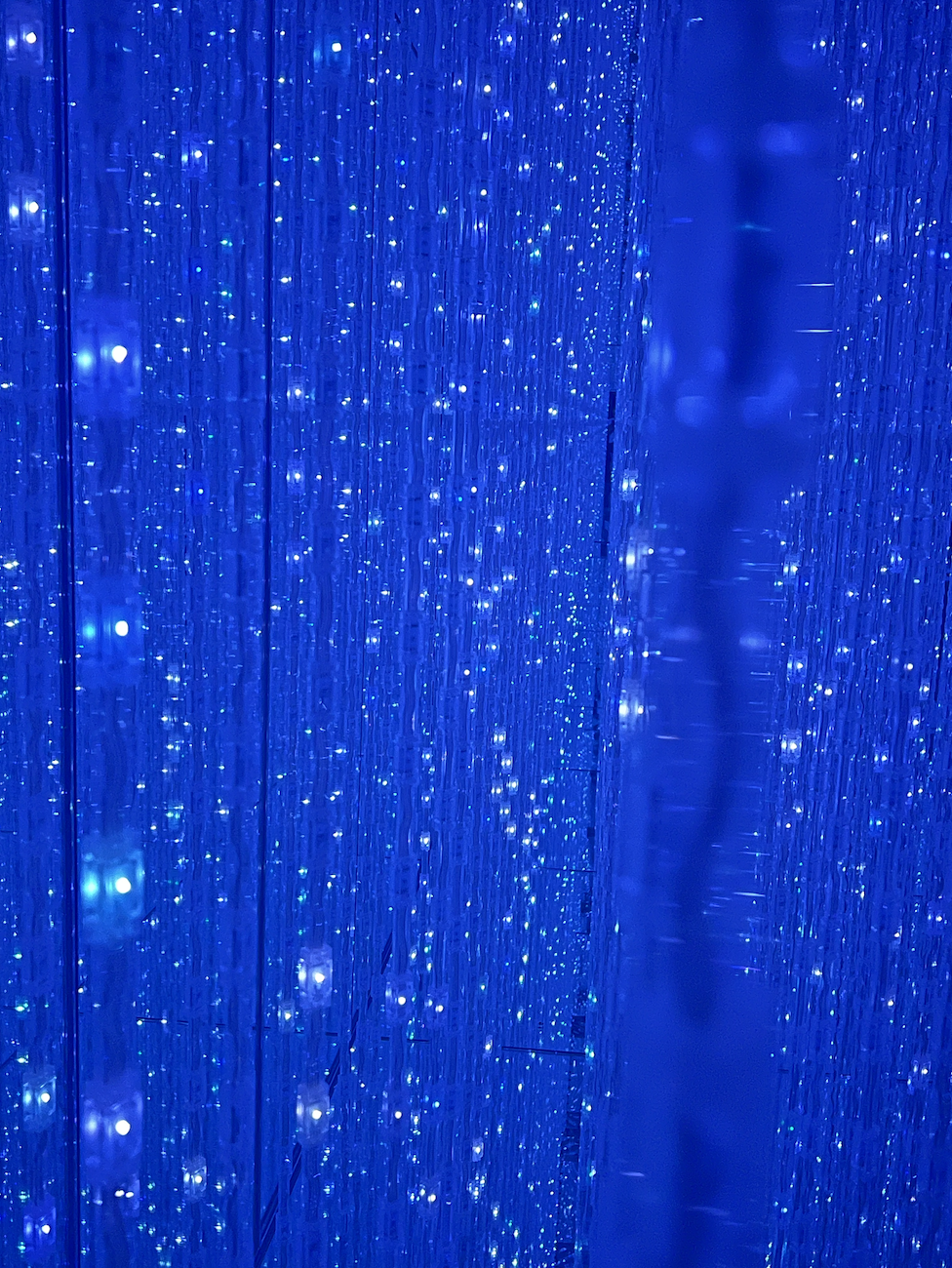
It is never entirely finished. But there’s something to be said about collaging these frameworks with visuals, like the still of TeamLab I took one evening in Tokyo, alone and mesmerized.
Just prior to going to Tokyo, I was chosen to be on a criminal trial as a juror. If you want to better understand how broken and unfair America can feel, sit on a jury trial for a few weeks and listen to testimony between those in power and those without, and try to make sense of many different interpretations of science. I left the experience objectively needing to see another view of the world other than a brutalist courtroom. The last time I had been to Tokyo was 7 years prior. I was younger and more excited. I thought parenthood was coming soon and life seemed thrilling. But parenthood never happened even after many difficult attempts. I remembered that energy I felt before boarding the plane alone. But I still wanted to go. There was something that pushed me there. I’ve loved this abstract idea of Japan since I was a child when Akira Kurosawa briefly came into my mother’s life, and subsequently mine. And as I waited to board the plane, I reminded myself I could visit Tokyu Hands and shop for my inexpensive soft body acrylics I got so much pleasure experimenting with. In the same way that room in Frankfurt felt fateful, something about boarding that flight to Tokyo did too.
A few days later, I decided it was time to go to Tokyu Hands. It was grossly humid and I was running late to meet up with someone I never met, so I did something I previously hadn’t done before alone in Tokyo. I took a car to get there. As we drove through Shibuya, out of the corner of my eye, I saw a blur of watercolored skaters, the Hockney image that has been a staple of life for the past 15 years. What? Did I just see what I saw? As I roamed Tokyu Hands, I couldn’t shake the feeling that the 3 Skaters were visiting Tokyo too.

After I bought the paints, I retraced my steps and found myself back to where I had driven by. And there it was in the window. My favorite watercolor. A piece I’ve been writing about for now a decade. First discovered in my friend’s Anne’s hospital room at Cedars. Halfway around the world, I wandered through the store dazed wondering if I had really seen what I had seen or was I just hallucinating? Was I being punked by some other being? To be far away from California with your favorite piece of art hanging in the window of a shop? What were the chances? What were the odds? I stood there and just gawked at the art in pleasure. The painting was different than the version I had in our bedroom. The trees were actually green, and the background wasn’t faded. I could stare at the full bodies of the 3 Skaters, who I’ve named more names than an expectant mother lists potential baby names over the many years of living with this piece of art and I saw them in a fuller, more vibrant way. The art looked entirely different than the version I had spent days of my life just staring at, imagining a myriad of stories of the three skaters of Venice Beach, but just unable to write them down. Maybe I just needed a more clearer version of what had always been right in front of me.
A few days later, we were wandering through Shimokitazawa when my eyes stopped at a display of Haribo Gummies. I always like to buy local gummies when I travel, especially funny ones, like the black licorice vampires that I first discovered in Berlin and refer to as “Berghain Haribo.” My eyes lingered at the words “Sunset Drive.”

The word “Sunset” is in yellow caps, and the word “Drive” is in a blue neon cursive with a pink sky and palm trees adorning the top of the packaging. A yellow bear with YouTube glasses poses in front of a pink sports car next to some icons of gummies palm trees, stars, roller skates and low riders. These are the ultimate Los Angeles David Hockney poster in sugar form. I took a picture of them, but for whatever reason didn’t buy them. A photo was enough. Then we flew back to LA.
A month passed, and I wrote some of the above, but it wasn’t to my liking. I’ve been trying to write a long trend report about all the things I’ve observed and seen during the summer, but I’ve also been quite frustrated by that project. It seems irrelevant in 2024 to spend time documenting a curious obsession with Japanese care robots. Then one day I walked into Larchmont Wine and I turned my head and there were the Sunset Drive gummies. It seemed like a sign that maybe these ideas had merit. So I bought a pack. I put it in the drawer of my painting desk and as I nibbled on them, I promised myself that it was indication I needed to unpack this summer. And that I wouldn’t finish eating them until I completed this piece of writing.
I’ve recently started spending more time in Malibu, a place I’ve never understood. It was Didion’s turf and many other writers had explored it. I never thought I had anything else to add and even to a native Angeleno, it always felt exclusionary. But last summer I was lucky enough to spend a day hanging out at Rick Rubin’s magical Shangri-La participating in my friend’s writing camp. I loved playing music for the other musicians as they wrote songs, although to be honest, I had the most fun sous-chefing in the 1950s kitchen, assisting on the ribs and realizing that if I spent enough time at that house, I’d focus and make something meaningful too. It was a different vista of Malibu and I dug it. Nature. Beauty. Focus. This summer I returned to Malibu a few days before my birthday and I spent an afternoon staring at the horizon thinking about nature news and realizing we had some of our own. At our house, the figs were about to ripen on the tree. I had been waiting for their arrival and watching their growth, anticipating when to harvest. Then one morning watching the birds in the garden from my perch below at the epsresso machine, I decided I wasn’t going to interfere with nature this year. The birds could eat the fruit. Feeling somewhat powerless at the state of the world, I realized the least I could do was to help feed the backyard birds through a tough year of climate change. Phyllis, who was one of the few people I made fig jam for, would have agreed. She passed last summer, so it seemed right to give the figs to the birds this year.
Back in Malibu, my friend too had nature news. There was a mouse that kept eating the inside of several cars. The neighbors were working together to trap them, but humanely. It was Malibu after all, but the mice were not taking the bait, so the trap just sat there in the driveway like a small piece of art. “How’s the mice coming along?” I asked her, and she gave me the update. Nature persisted. The mice roamed free.
Summer is over now even if it’s 104 degrees outside. Last night, I found the last Haribo Sunset Drive gummy, a yellow roller skate, a small piece of my Hockney, slightly shriveled in the drawer of my painting desk. I briefly examined it, then decided to eat it before reminding myself, “Finish that essay. It’s time to move on!” Moving on is not something that comes naturally to me, but I’m trying. I’ll also admit not all essays have good beginning, middles and ends, and this one surely doesn’t. But I still believe others will, and hopefully the fig tree will bloom again next summer.
9.5.24
 Carly Eiseman